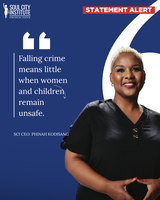
When Crime Falls, But Women Are Still Not Safe
These gains matter.
But there is another part of the crime picture that demands our attention: women and children are still not safe.
A decline in carjackings cannot become a reason for us to declare victory while gender-based violence and femicide remain deeply embedded in our society. Safety is not simply about whether a woman can drive home without being hijacked. It is also about whether she can arrive home without being assaulted by someone she knows. Whether she can leave an abusive relationship without being killed. Whether a girl can walk through her community without fear of sexual violence. Whether a child can sleep safely in the place that should protect them most.
If women are unsafe in their homes, relationships and communities, then South Africa is not yet safe.
This is why we must resist the temptation to view crime through a single lens.
The Acting Minister of Police, Firoz Cachalia, has highlighted the distinction between violent crimes associated with organised criminal groups and interpersonal crimes committed by people known to their victims. This distinction is important because different forms of violence require different prevention and response strategies. (IOL, 28 August 2026)
That distinction is critical.
We cannot police our way out of GBVF alone.
GBVF is not only a criminal justice problem. It is also a social, economic, cultural, educational and public health crisis. It is about power, inequality, harmful gender norms, substance abuse, socialisation, economic dependency, inadequate support systems and the normalisation of violence.
This is where prevention must become much more than a slogan.
For too long, South Africa has responded to violence after it has happened: after the woman has been beaten, after the child has been sexually violated, after the warning signs have been ignored, after a family has been destroyed.
We need to become much better at preventing violence before it happens.
That means investing in programmes that challenge harmful masculinities and engage men and boys as partners in prevention. It means teaching children about consent, respect, boundaries and healthy relationships. It means ensuring survivors can access quality services without being blamed, humiliated or forced to repeatedly tell their stories. It means strengthening the criminal justice system so that perpetrators know that violence will have consequences.
And it means listening to women.
Survivors cannot simply be invited into panels, campaigns and conferences so that institutions can say they have included their voices. Their experiences must influence policy, programming, budgeting and accountability.
There is also an urgent need for better data.
It is difficult to defeat what we cannot properly see. Concerns have been raised about the absence of disaggregated information on crimes against women and children in recent SAPS quarterly crime reporting. Researchers and civil society organisations have warned that gaps in this data make it more difficult to understand the nature and extent of violence against women and children, identify those most at risk and assess whether interventions are working. (Daily Maverick, 29 June 2026)
SAPS has indicated that concerns around data integrity, including discrepancies, duplication and challenges with victim-linking and demographic variables, contributed to the withdrawal of some disaggregated statistics while the data was reviewed and validated. (Daily Maverick, 29 June 2026)
Reliable, transparent and consistent data is not a bureaucratic luxury. It is essential for knowing where violence is happening, who is most at risk, what interventions are working and where resources must be directed.
At Soul City, we believe that changing the story of violence requires changing the social conditions that make violence possible.
Crime prevention must therefore be accompanied by violence prevention.
We should celebrate every life saved because a carjacking did not happen. But we must ask the same question about every woman who lives in fear of the person sleeping beside her.
We should celebrate fewer robberies. But we must also ask why so many women still have to develop survival strategies simply to navigate relationships, workplaces, public spaces and their own homes.
We should celebrate a reduction in murder. But we cannot become comfortable while femicide continues to rob families of mothers, daughters, sisters and friends.
The latest statistics give us two messages at once:
Progress is possible. But our work is far from complete.
South Africa needs a definition of safety that includes women and children.
A country cannot claim to be safe because its cars are safer from hijackers while its women remain unsafe from intimate partners.
We need policing that is effective.
We need justice that is accessible.
We need services that support survivors.
But above all, we need prevention that changes the attitudes, behaviours and systems that allow violence to flourish.
Because the ultimate measure of a safer South Africa should not only be how many crimes we prevent on our streets.
It should be whether women and children can live their lives without fear.
That is the South Africa we must build.
References
- South African Police Service (SAPS). 2026/27 First Quarter Crime Statistics, covering April–June 2026. SAPS official crime statistics.
SAPS Crime Statistics - IOL. “Murder, carjackings and robberies decline, GBVF rises”, 28 August 2026. Reporting on the latest SAPS crime statistics and comments by Acting Minister of Police Firoz Cachalia.
IOL report - Daily Maverick. “Missing stats on crimes against women, children in SAPS quarterly reports a troubling trend”, 29 June 2026. Reporting on the absence of disaggregated crime data and concerns raised by researchers and civil society.
Daily Maverick report