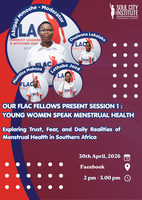
Young women are speaking are we listening? The reality of menstrual health in Southern Africa
For many young women, the first experience of menstruation is not met with celebration or understanding but with fear, silence, and confusion.
“I didn’t tell anyone the whole day.”
“I was embarrassed… I didn’t even want to use a pad.”
“I got laughed at because of stains.”
These are not isolated stories. They are everyday realities. During the Young Women Speak: Trust, Fear & Realities of Menstrual Health webinar, young women from in our FLAC fellowship from Botswana, eSwatini and South Africa came together to share their lived experiences. What emerged was not just a conversation about periods but a powerful call for dignity, access, and systemic change.
The Silence Starts Early
Many girls begin their menstrual journey unprepared. Despite being a natural biological process, menstruation is still treated as something secretive and shameful. Instead of open conversations, girls are often left to figure it out on their own hiding stains, avoiding questions, and carrying the emotional weight of stigma. This silence doesn’t just affect confidence. It shapes how young women understand their bodies, their health, and their rights.
Stigma Is Still a Daily Reality
Across communities, harmful myths persist:
- That menstruation is “dirty” or “impure”
- That girls should hide their pads
- That talking about periods is inappropriate
These beliefs create an environment where girls feel ashamed of something completely natural. Even more concerning is how this stigma is reinforced not only by communities, but sometimes by peers, schools, and even institutions meant to support them.
Access Is Not Equal
For many young women, managing a period is not just about biology, it’s about resources.
In rural and low-income communities:
- Pads are unaffordable or unavailable
- Clinics are far and costly to access
- Infrastructure challenges make movement difficult
Some girls resort to unsafe alternatives. Others miss school. Many suffer in silence.
This is the reality of period poverty and it continues to affect thousands across the region.
When Pain Is Ignored
Another critical issue raised was how menstrual pain is often dismissed.
Young women spoke about:
- Severe cramps being normalised
- Being expected to “push through” pain at school or work
- Lack of access to proper medical support
The message society sends is clear: “This is just part of being a woman.”
But pain that disrupts daily life is not something to ignore. It is a health issue one that deserves attention, care, and policy response.
The Digital Dilemma
In today’s world, many young people turn to social media for answers. And while it can be a powerful tool for education and empowerment, it also comes with risks.
Unverified advice, influencer opinions, and misinformation can lead to:
- Unsafe health practices
- Confusion about products and care
- Delayed access to professional help
Without proper guidance, social media becomes a double-edged sword.
Why Inclusion Matters
One of the strongest messages from the discussion was this:
Menstrual health is not just a “girls’ issue.”
Excluding boys and men from the conversation fuels stigma and misunderstanding. Inclusion, on the other hand, builds empathy, support, and shared responsibility.
Fathers, brothers, teachers, and peers all have a role to play in creating environments where girls feel safe, supported, and respected.
Beyond Pads: A Human Rights Issue
Menstrual health is often reduced to access to pads. But the reality is much broader.
It is about:
- Dignity
- Access to healthcare
- Education
- Economic equality
- Freedom from shame and discrimination
When girls cannot manage their periods safely and confidently, it affects every aspect of their lives from education to mental health.
So, What Needs to Change?
The young women in this conversation didn’t just share problems they pointed toward solutions:
· Free or affordable menstrual products in schools, clinics, and communities
· Comprehensive education that starts early and includes everyone
· Responsive healthcare services that take menstrual pain seriously
· Safe spaces for open dialogue
· Stronger partnerships between government, civil society, and the private sector
Most importantly, they called for a shift in mindset from silence to openness, from stigma to support.
The Power of Speaking Out
This webinar was more than a discussion. It was a reminder that young women are already leading the change.
They are questioning harmful norms.
They are sharing their stories.
They are demanding better systems.
But they cannot do it alone.
A Call to Listen and Act
If there is one message that stands out, it is this:
Menstrual health is not a privilege. It is a right.
No girl should have to:
- Miss school
- Feel ashamed
- Risk her health
- Or suffer in silence
The question is no longer whether change is needed.
The question is: Are we ready to act?
#YoungWomenSpeak #MenstrualHealthMatters #EndPeriodPoverty #SRHR #BreakTheStigma