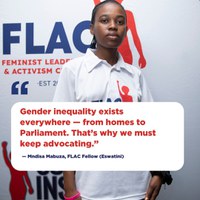
From Homes to Parliament: What I’ve Learned as a FLAC Fellow
Meet Mandisa Mabuza, a passionate advocate using her voice to champion women’s rights across Africa. Through her journey, she has gained powerful insights into the realities of gender inequality — from the lived experiences of domestic workers to the structures of leadership on the continent.
Seeing the Invisible: The Reality of Domestic Workers
One of the most eye-opening moments in my journey as a FLAC Fellow was visiting the Izwi Domestic Workers Alliance. This experience exposed me to the harsh and often invisible realities that many domestic workers face daily.
I learned that many domestic workers experience various forms of abuse, including violence and unfair treatment. These are women who work in private spaces, often without adequate protection or access to justice. Their vulnerability is heightened by the fact that their workplaces are hidden behind closed doors.
This experience made one thing clear: knowing your rights is not a luxury — it is a necessity. Empowering women with information about their rights is a critical step toward challenging exploitation and violence. It also reinforced the importance of creating safe platforms where women can speak up and be heard.
Leadership Gaps: Women in Decision-Making Spaces
My visit to the Pan African Parliament highlighted another dimension of gender inequality — the underrepresentation of women in leadership.
Despite progress in many areas, there is still a significant gap when it comes to women occupying decision-making positions. In some cases, only one woman is selected in a five-year delegation. This reality reflects broader systemic barriers that continue to limit women’s participation in leadership across the continent.
Representation matters. When women are excluded from these spaces, their voices, experiences, and needs are also excluded from policies and decisions that affect their lives.
Connecting the Dots: Inequality at Every Level
What stood out to me most from these experiences is that gender inequality exists at every level of society.
It exists in homes, where domestic workers may face abuse and exploitation.
It exists in institutions, where women remain underrepresented in leadership.
These are not separate issues — they are deeply connected. They are all part of a system that continues to marginalise women in different ways.
Why Advocacy Matters
My journey as a FLAC Fellow has deepened my understanding of the urgent need for advocacy. Change does not happen on its own — it requires voices, action, and collective effort.
Advocating for women’s rights means:
- Raising awareness about injustice
- Empowering women with knowledge
- Challenging harmful systems and norms
- Creating space for women to lead
It means ensuring that women are safe, heard, and represented — in their homes, in their communities, and in positions of power.
A Call to Action
We all have a role to play in advancing gender equality.
We must listen to the voices of women whose experiences are often overlooked.
We must challenge systems that exclude and silence women.
And we must continue to advocate for a future where all women can live with dignity, safety, and equal opportunity.
Because true equality will only be achieved when no woman is left behind.
#FLACFellows #WomensRights #GenderEquality #SoulCityInstitute #Eswatini
By Mandisa Mabuza, FLAC Fellow (Eswatini)