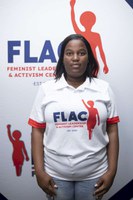
Freedom Day Statement
It was the day we chose democracy. It was the day we voted for freedom. It was the day we began to believe that a different South Africa was possible.
But as I reflect on Freedom Day today, I want to be honest about something that history books sometimes soften: freedom did not arrive equally for everyone. It did not arrive fully. And it did not arrive safely for all.
Yes, we celebrate 1994 as a turning point. Yes, we honour the courage of those who fought against apartheid and dismantled a system built on racial oppression. But as a young feminist, I also understand that while we removed one system of oppression, others continued to exist quietly, structurally, and often invisibly.
Freedom Day is therefore not just a celebration for me. It is a mirror. It forces us to ask difficult questions about the kind of freedom we have, and the kind of freedom we still need to build.
Because what is political freedom if a woman is still not safe in her own home? What is democracy if girls are still afraid to walk alone at night? What is equality if gender-based violence continues to shape the daily reality of so many women in this country?
We often speak about freedom as if it is complete, as if 1994 was the final destination. But I believe Freedom Day is not a full stop. It is a comma. It is a pause in a much longer sentence a sentence that we are still writing together as a nation.
For many women and girls in South Africa, freedom is still conditional. It depends on where you live, how you look, how much money you have, and whether the systems meant to protect you actually respond when you need them. A woman cannot be considered free if she has to calculate her safety every time she leaves her house. She is not free if she has to choose between opportunity and protection. She is not free if her voice is still dismissed, silenced, or questioned in spaces where decisions are made about her life.
We must also confront the uncomfortable truth that violence against women is not just an individual problem it is a societal one. It is shaped by attitudes, by silence, by systems that too often fail to act with urgency. And it is sustained when we treat it as normal instead of treating it as unacceptable.
As a young woman, I refuse to accept that normal.
Freedom must mean more than the absence of apartheid laws. It must mean the presence of dignity. It must mean safety in every space public and private. It must mean equal access to education, employment, and leadership without discrimination. It must mean that a girl growing up in South Africa today can imagine a future without fear limiting her choices.
But I also want to speak about hope, because Freedom Day is not only about what is broken. It is also about what is possible.
We come from a history of resistance. We are descendants of people who refused to accept injustice as destiny. We are proof that systems can be dismantled when people organise, speak out, and refuse to be silent. That same spirit is still alive in young people today in activists, students, community leaders, and everyday citizens who continue to push for change.
As a feminist, I believe that our struggle today is to expand the meaning of freedom. To ensure that it is not only political, but also social, economic, and personal. To ensure that freedom includes bodily autonomy, safety, respect, and equality for all genders.
We must also recognise that men have a role in this journey. Ending gender-based violence is not only a women’s issue. It is a human issue. It requires accountability, education, and a collective shift in how we understand power, respect, and relationships.
On this Freedom Day, I do not only want to remember 1994. I want to build on it. I want us to ask: what would South Africa look like if freedom was truly complete? What would it look like if every woman and girl could live without fear? What would it look like if equality was not just written in the Constitution, but lived in every household, school, workplace, and street?
I believe that vision is still possible. But it requires action, not just celebration. It requires honesty, not just pride. And it requires all of us to continue the work that was started long before 1994 and continues long after it.
Freedom Day reminds us that we have already achieved what once seemed impossible. That knowledge should give us courage for the work still ahead.
Because the truth is this: we are not done yet.
And until every woman and girl in South Africa can live freely, safely, and fully our freedom remains unfinished.
This is the South Africa we are still building.