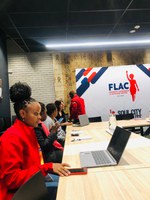
Building Cross-Border Feminist Solidarity in a Digital Age: Reflections from Women Deliver Melbourne
The session opened with a warm welcome and acknowledgement of the traditional custodians of the land, the Wurundjeri people of the Kulin Nation. This grounding moment reminded participants that all global conversations on justice and equality must begin with recognition of history, place, and ongoing struggles for sovereignty and dignity.
From the outset, the tone of the gathering was clear: this was not only a moment of exchange, but a moment of alignment. Participants were invited into a shared space of learning, where the urgency of global gender inequality met the practical realities of advocacy, programming, and digital engagement.
A Shared Struggle, A Shared Responsibility
One of the strongest reflections emerging from the session was the idea that feminist struggles, while expressed differently across contexts, are deeply interconnected. As highlighted during the discussion, communities may experience inequality in distinct ways, but the underlying systems shaping those experiences are shared across borders.
This framing shifted the conversation away from isolated interventions toward a broader understanding of collective responsibility. Rather than exporting solutions from one context to another, participants emphasised the importance of amplifying local leadership and respecting contextual knowledge. Real solidarity, as expressed in the dialogue, is not symbolic it is active, sometimes uncomfortable, and requires a willingness to challenge injustice even within one’s own spaces.
Solidarity was described as something that “costs something,” particularly when it involves using platforms to speak against inequality in ways that may be politically inconvenient. Yet, it is precisely this willingness to act beyond comfort that defines meaningful feminist collaboration.
Digital Spaces as Sites of Power
A key focus of the conversation was the role of digital platforms in expanding feminist impact. Participants reflected on how digital tools have shifted the landscape of advocacy, allowing organisations and activists to extend their reach far beyond physical spaces.
Social media, in particular, was described as a “low-hanging fruit” that can be leveraged to amplify messaging, translate content across languages, and connect with wider audiences. Platforms such as Facebook, Instagram, and LinkedIn were highlighted as accessible tools that enable organisations to reach individuals who may never physically attend workshops, trainings, or community meetings.
Importantly, the discussion also pointed to the potential of digital innovation beyond traditional social media. Ideas such as helplines, chatbots, and online support systems were raised as ways to ensure that services and information remain accessible regardless of geography or financial barriers.
In this sense, digital transformation is not simply about communication it is about accessibility, inclusion, and democratising access to support systems.
From Local Action to Global Impact
The session also emphasised the evolving role of organisations working in feminist spaces. Rather than limiting impact to localised programming, there is a growing recognition of the importance of building global networks of collaboration.
Through partnerships, cross-border engagement, and shared learning spaces, organizations are increasingly able to extend their influence into different regions and sectors. This shift allows for messaging and advocacy to move across “different spheres” while still maintaining local grounding.
Participants reflected on how this approach enables more dynamic and responsive feminist work that is not confined by geography but strengthened by it.
Feminist Leadership and the Future of Collaboration
A significant moment in the discussion cantered on feminist leadership development and the role of programmes such as the Feminist Leadership and Activism Centre (FLAC). These initiatives were highlighted as essential in shaping a new generation of leaders who are not only grounded in local realities but also equipped to engage in global feminist movements.
The conversation pointed to the importance of intergenerational and transnational collaboration, particularly in spaces like Women Deliver, where diverse actors come together to exchange ideas and strategies.
Looking ahead, there was a strong sense of optimism about the potential for new partnerships and meaningful collaborations emerging from such gatherings. The shared hope was that participants would leave not only with insights, but with strengthened networks and renewed commitment to collective action.
Closing Reflections
As the session came to a close, the emphasis returned to gratitude and connection. Appreciation was extended to all participants, including those joining remotely across time zones, reinforcing the idea that feminist solidarity is not bound by physical presence.
The gathering concluded with a reminder that while feminist work is often complex and ongoing, it is also deeply relational. It is built through conversations, shared meals, digital exchanges, and moments of recognition across difference.
In Melbourne, this side event offered more than dialogue it offered a reminder that feminist solidarity is both a practice and a commitment. And as participants return to their respective contexts, the challenge remains: to translate these global conversations into sustained local and digital action that advances equality for all.